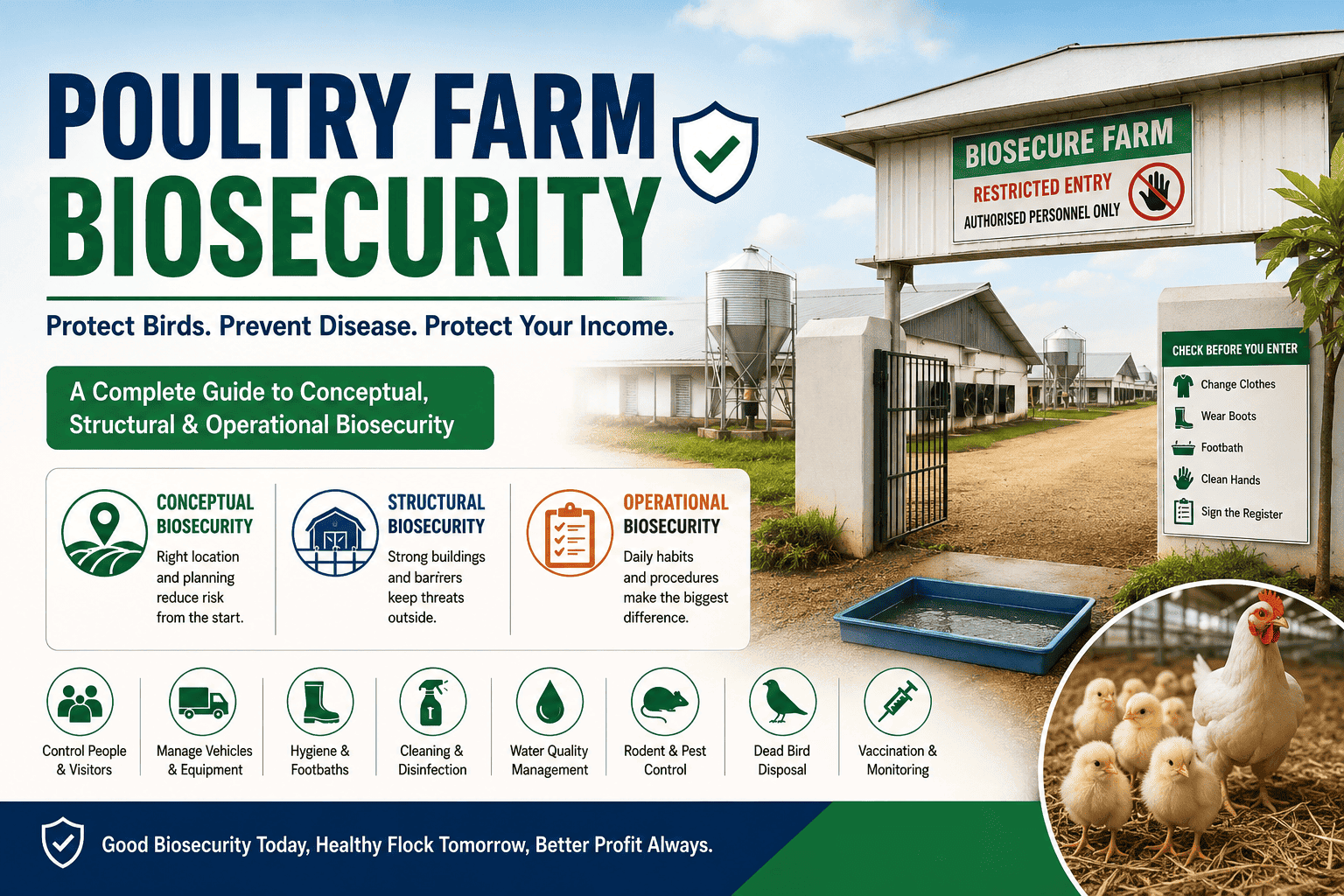

A disease outbreak can wipe out months of poultry-farming income in a very short time.
The loss is not limited to the birds that die. A farmer may also face poor feed conversion, reduced egg production, medication costs, additional labour, disposal expenses, cleaning and disinfection costs and, in serious situations, interruption of farm operations.
This is why I consider biosecurity one of the most important investments in a poultry farm.
Many farmers think biosecurity means spraying disinfectant or keeping a footbath at the entrance of the shed. It is much more than that.
Biosecurity starts before the first bird arrives at the farm. The location of the farm, distance from other poultry operations, movement of people and vehicles, water source, shed construction, rodent control, wild-bird control and daily working practices all have a role to play.
In simple words, the objective is to prevent disease-causing organisms from entering the farm and, if they do enter, prevent them from spreading between birds, sheds or farms.
The Government of India’s poultry biosecurity guidance similarly treats biosecurity as an integrated programme covering farm location and design, access control, traffic, cleaning and sanitation, personnel hygiene, feed and water, dead-bird disposal, vaccination, flock monitoring and other disease-control measures.
Table of Contents
ToggleTypes of Biosecurity in Poultry Farming
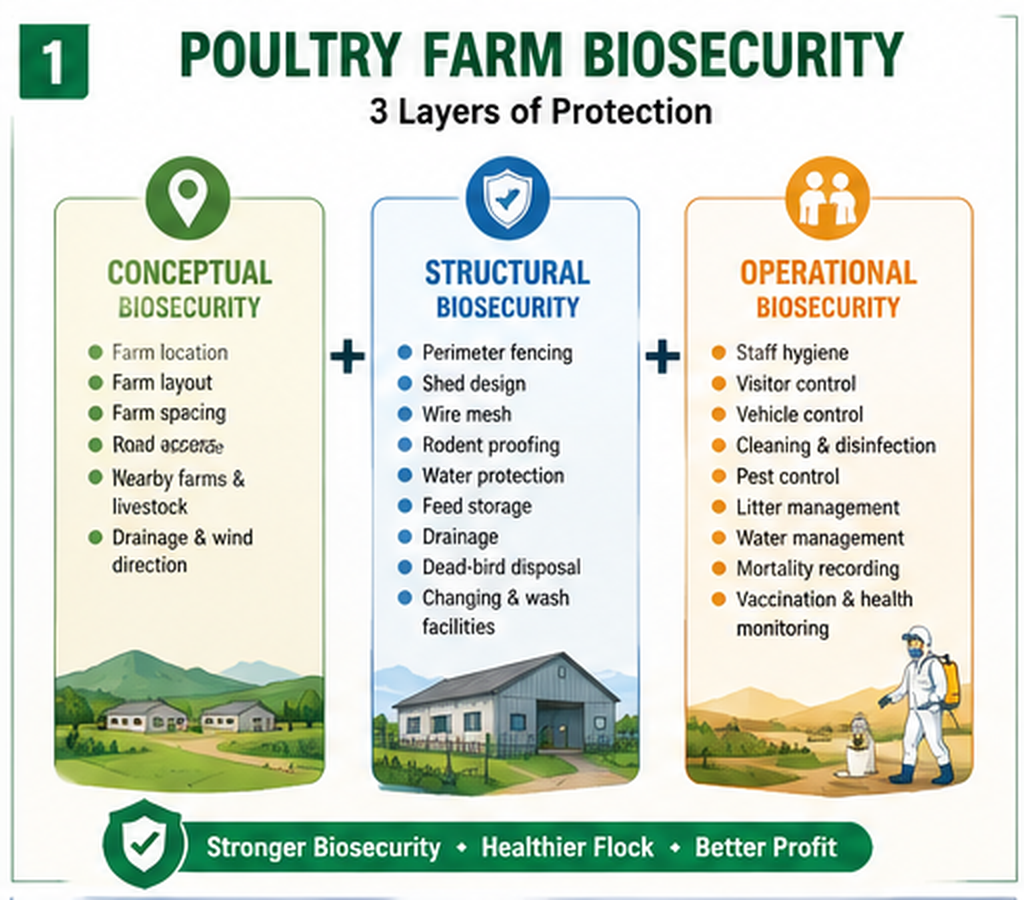
For practical farm management, poultry biosecurity can be understood through three main areas:
Conceptual Biosecurity
Structural Biosecurity
Operational Biosecurity
Current Indian guidance also uses related categories such as managemental and personnel biosecurity. The terminology may differ slightly between guidelines, but the basic objective remains the same: prevent the entry and spread of pathogens.
All three areas are connected.
You can have a beautifully designed poultry shed, but if workers and visitors enter it with contaminated footwear, the building alone will not protect the flock.
Similarly, you may have excellent staff hygiene, but if the farm is located in a high-risk area and has uncontrolled movement of vehicles, people or animals, the disease risk remains.
Let’s discuss them one by one.
What Is Conceptual Biosecurity?
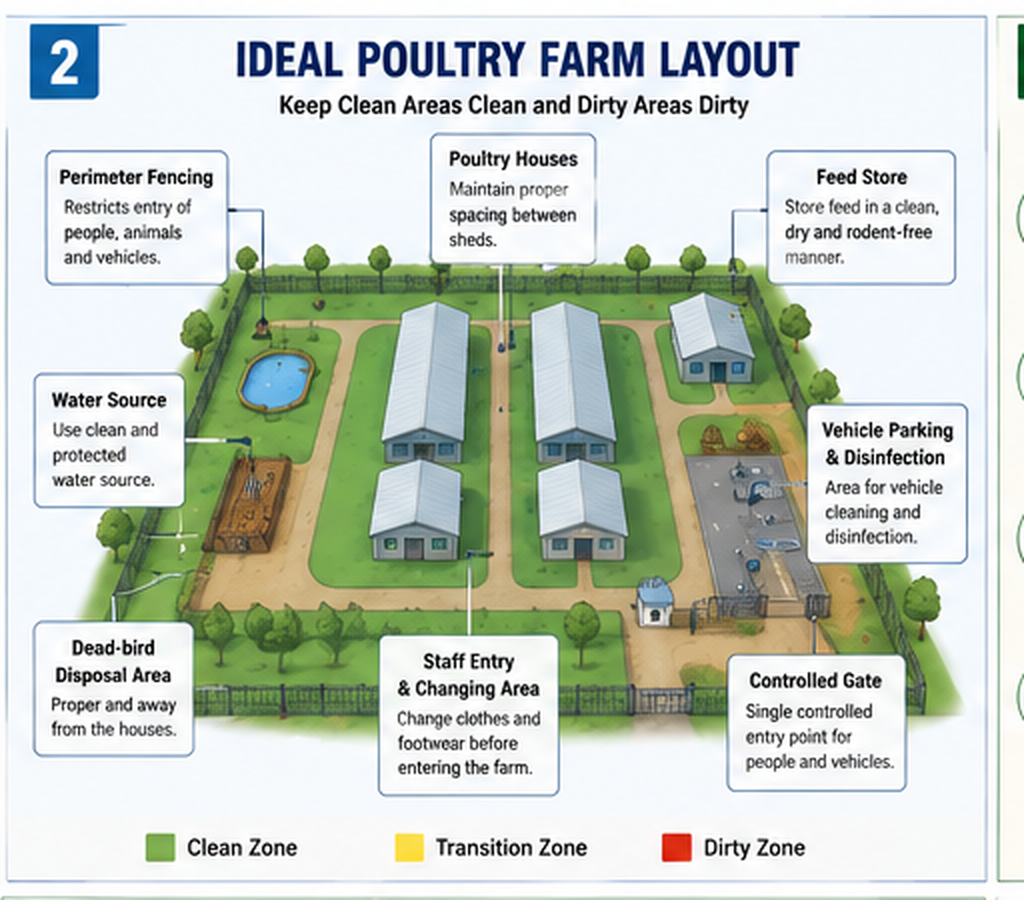
Conceptual biosecurity means the precautions taken while selecting the farm location and planning the farm layout.
This is the stage where farmers have one of the best opportunities to prevent future problems.
Once a poultry shed has been constructed, changing its location is obviously not practical.
Important factors include:
- Distance from other poultry farms
- Access roads
- Traffic movement
- Water sources
- Drainage
- Prevailing wind
- Nearby livestock operations
- Hatcheries and processing facilities
- Waste-disposal areas
- Residential areas
- Presence of wild birds
Why Is Farm Location Important?
This question looks very basic, but it is not.
When purchasing land, a farmer usually thinks about the price of the land, electricity, water and road connectivity. Biosecurity sometimes comes much later.
That can become an expensive mistake.
Current DAHD guidance recommends considering farm location, layout, water sources, disease prevalence and proximity to other farms while designing a biosecurity programme.
Distance From Other Poultry Farms
A new poultry farm should preferably be located away from other poultry farms and other potential sources of infection.
There is no single distance that can safely be treated as a universal rule for every poultry farm. Requirements and recommendations can vary according to the type of operation, local disease situation and applicable guidance.
For example, Tamil Nadu Agricultural University guidance has recommended approximately 1.6 km for commercial layer/broiler farms and 3 km for breeder farms as a conceptual-biosecurity measure.
So, when selecting land, don’t simply ask:
“Is this land cheap and does it have water?”
Also ask:
- What poultry farms are nearby?
- Are there livestock farms nearby?
- Are there water bodies attracting wild birds?
- Where do poultry vehicles travel?
- How will people and materials enter the farm?
- Can different sheds and age groups be separated effectively?
These questions can save a farmer from a lot of trouble later.
Distance Between Poultry Sheds
Adequate separation between poultry houses is important for ventilation, access, cleaning, fire safety and disease control.
I would not recommend treating a particular number of feet as a universal biosecurity rule.
Shed spacing should take into account:
- Building design
- Ventilation
- Prevailing wind
- Farm size
- Stocking density
- Vehicle movement
- Fire safety
- Local requirements
The basic principle is simple:
Don’t build sheds so close together that they interfere with ventilation, movement control or disease separation.
Road Connectivity
Good road connectivity is important for poultry farming.
Feed has to come in. Birds, eggs, equipment and other materials have to move. Veterinarians and service providers also need access.
But there is a difference between having a good access road and allowing uncontrolled traffic through the farm.
I prefer a farm layout where the entrance is controlled and unnecessary vehicles do not move close to poultry houses.
Where practical:
- Keep a defined farm entrance.
- Restrict unnecessary traffic.
- Record important visitors and vehicles.
- Keep internal roads clean.
- Provide appropriate vehicle-cleaning and disinfection arrangements.
- Avoid bringing vehicles directly into production areas after visiting high-risk poultry premises without appropriate biosecurity measures.
Water Source
Water is another point that farmers should check before purchasing land.
It is not enough to say:
“There is plenty of water here.”
We need to ask whether the water is clean, reliable and suitable for poultry consumption.
A contaminated water source can become a continuous source of exposure because birds drink it every day.
Water should therefore be tested periodically using a testing programme appropriate to the water source and farm risk.
What Is Structural Biosecurity?
Structural biosecurity refers to the physical features of the farm that help prevent disease entry and spread.
This includes:
- Perimeter fencing
- Controlled entry
- Poultry-house design
- Wire mesh
- Rodent proofing
- Protected water sources
- Feed storage
- Drainage
- Changing facilities
- Wash facilities
- Vehicle hygiene facilities
- Safe disposal arrangements for dead birds
DAHD guidance similarly identifies fencing, controlled entry, housing design, drainage, feed storage, dead-bird disposal and worker facilities as important structural-biosecurity components.
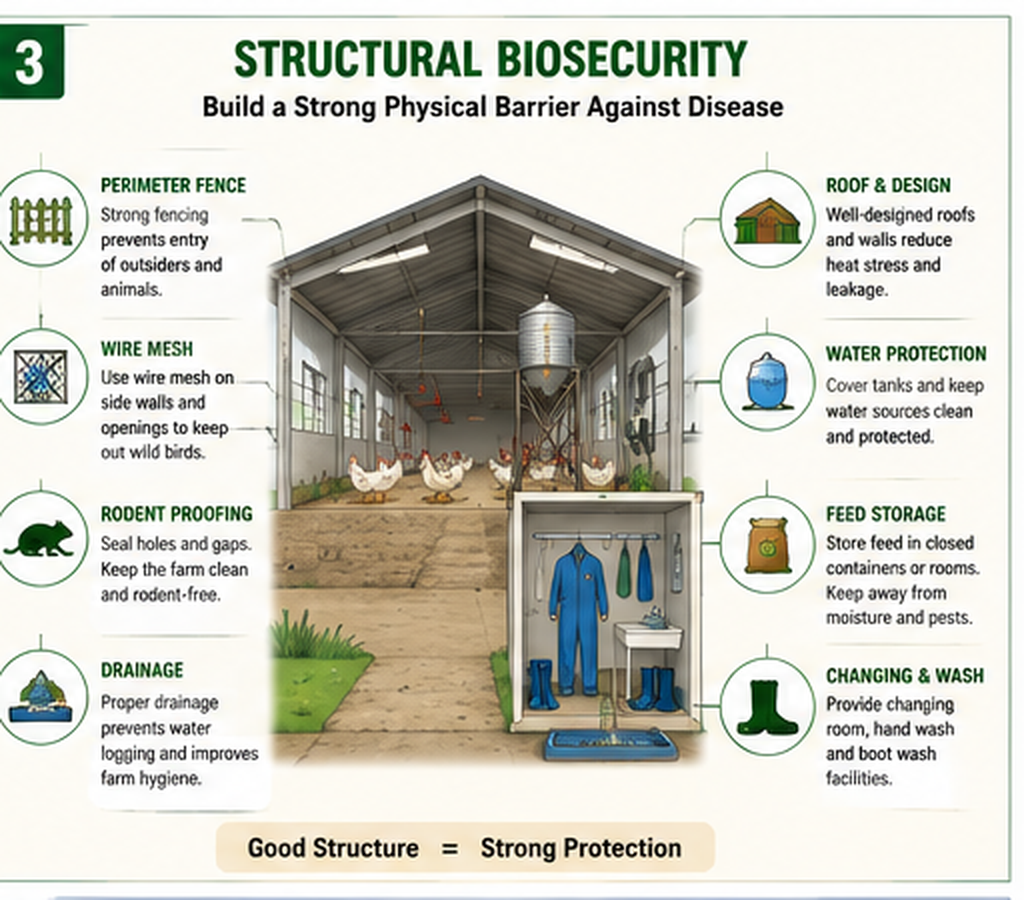
Perimeter Fencing
Fencing serves two purposes.
The first is obvious: security.
Poultry farms can face theft, trespassing and unwanted visitors. But fencing is also useful from a biosecurity point of view because it helps control who and what enters the farm.
A controlled entrance makes it easier to implement farm rules.
I would also recommend displaying a simple sign such as:
RESTRICTED AREA – NO UNAUTHORISED ENTRY
It may sound like a small thing, but people are more likely to follow a rule when the rule is clearly communicated.
Trees Around the Poultry Shed
This is an area where farmers should think carefully.
Trees can provide shade and help reduce heat around a farm. But dense vegetation immediately around poultry houses can make surveillance difficult and may provide shelter or roosting opportunities for wild birds and other animals.
Government of India guidance specifically advises avoiding trees or dense foliage around sheds where they can provide roosting opportunities for wild birds.
So I am not saying:
“Never plant trees on a poultry farm.”
I am saying:
Don’t allow uncontrolled vegetation immediately around the poultry houses.
Maintain a clear and manageable area so that the shed remains easy to inspect.
Wild Birds
Wild birds deserve special attention.
They may visit water sources, feed-storage areas, rooftops or trees around the farm and can become a potential pathway for disease transmission.
Wire mesh and suitable physical barriers can help prevent wild birds from entering poultry houses.
Feed should also be stored in a manner that does not attract wild birds.
This is particularly important in India because avian-influenza preparedness includes surveillance around poultry farms, migratory-bird habitats and other high-risk areas.
Rodent Proofing
Rodent control is one of those jobs that is easy to postpone.
That is a mistake.
I have seen situations where farmers noticed rodent activity but did not take it seriously until the problem became much bigger.
Rodents can contaminate feed, water and equipment and can move between different areas of a farm.
A poultry farm should therefore have a proper rodent-control programme.
Some basic measures are:
- Keep feed stores clean.
- Clean feed spills immediately.
- Seal gaps in buildings.
- Keep vegetation under control.
- Remove unnecessary material where rodents can hide.
- Monitor rodent activity.
- Use an appropriate pest-control programme.
The area around poultry houses should be kept sufficiently clear to allow regular inspection.
Protect the Water
Open water sources can attract wild birds and other animals.
If a farm uses a water tank, reservoir or other storage system, it should be protected from contamination.
Water lines also need attention. It is possible to have good-quality water at the source and still have a problem inside the farm’s water system because of contamination or biofilm.
That is why water management is a continuous process, not a one-time test.
DAHD’s current veterinary treatment guidance also recommends routine water sanitation and testing, together with attention to biofilm inside pipelines where contamination is found.
What Is Operational Biosecurity?
Operational biosecurity is about what happens every day.
This is where even a well-designed farm can fail.
A farmer may spend lakhs on a poultry shed, fencing and equipment, but if workers move freely between sheds, visitors enter without control and dirty equipment is shared between flocks, the investment in infrastructure loses much of its value.
Operational biosecurity includes:
- Staff movement
- Visitor control
- Vehicle movement
- Clothing and footwear
- Cleaning and disinfection
- Vaccination
- Pest control
- Litter management
- Mortality recording
- Water management
- Disease-response procedures
DAHD describes operational biosecurity as the regular protocols followed during day-to-day farm operations, including visitor management, cleaning and disinfection, vehicle hygiene, worker hygiene, feed and water hygiene, pest control, mortality disposal and health monitoring.
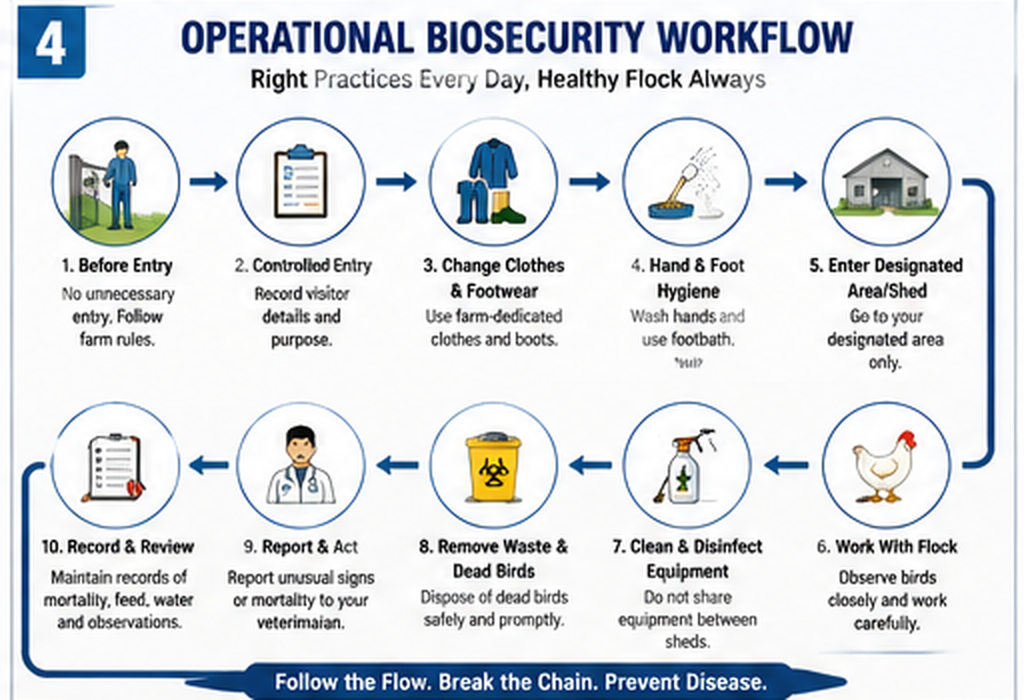
Control Movement Between Sheds
Different age groups should ideally be managed in a way that reduces cross-contamination.
Where farm size allows it, dedicated workers for different production areas can be useful.
If that is not practical, movement should be controlled and hygiene procedures followed between sheds.
One basic principle is to avoid moving from a higher-risk or older flock to a younger or more susceptible flock without taking appropriate precautions.
Where practical, an all-in/all-out approach by age group can also help reduce disease transmission. India’s avian-influenza action plan recommends a uniform age-group policy and identifies all-in/all-out production as the preferred approach where feasible.
Staff Clothing and Personal Hygiene
Farm workers should use farm-dedicated clothing and footwear.
Depending on the farm’s biosecurity programme, this may include:
- Farm clothing
- Dedicated boots
- Apron or coveralls
- Gloves
- Mask
- Hair covering
For higher-risk operations, shower-in/shower-out procedures may also be appropriate.
And there is one very simple rule that is sometimes forgotten:
Dirty footwear should not walk straight into a clean poultry shed.
Visitors
My preference is simple:
Keep unnecessary visitors out of the poultry house.
A feed supplier, electrician, veterinarian or other essential person may need to enter. But a visitor who has no reason to enter the shed should not be allowed inside simply because he wants to see the birds.
Visitors should be recorded and should follow the farm’s hygiene and clothing requirements.
Government guidance recommends restricting entry to essential personnel, maintaining visitor records and providing appropriate protective clothing and footwear.
Vehicle Biosecurity
Vehicles are often overlooked.
A vehicle can visit several poultry farms in a single day.
It may carry soil, litter, manure or other contaminated material on tyres, wheel arches and other surfaces.
Therefore:
- Restrict unnecessary vehicle entry.
- Define where vehicles can park.
- Keep high-risk vehicles away from poultry houses where possible.
- Clean and disinfect vehicles according to the farm protocol.
- Pay particular attention to vehicles coming from other poultry farms, markets or slaughter facilities.
Cleaning and Disinfection
Cleaning and disinfection are not the same thing.
This is important.
If a shed contains a lot of organic material, simply spraying disinfectant over it is not going to solve the problem.
A practical cleaning programme should include:
- Remove the birds.
- Remove litter and organic material.
- Dry-clean the house.
- Clean equipment.
- Wash surfaces properly.
- Rinse where appropriate.
- Allow surfaces to dry.
- Apply a suitable disinfectant according to the manufacturer’s instructions.
- Inspect the house before the next flock enters.
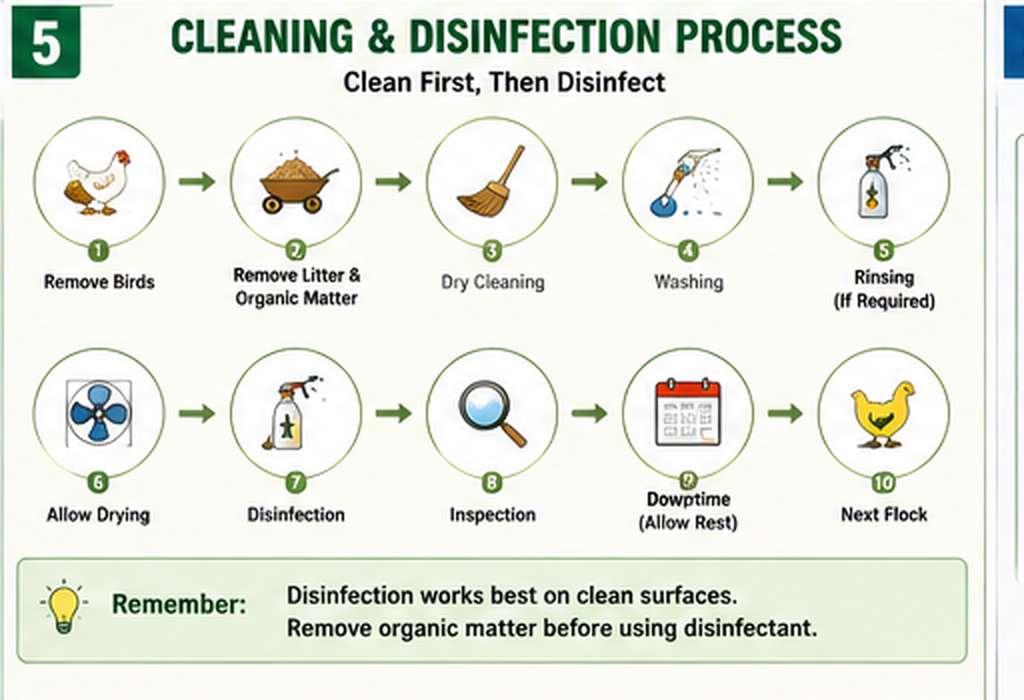
The Government of India and WOAH both emphasise cleaning, disinfection, equipment hygiene and appropriate downtime as important parts of poultry biosecurity.
What About Downtime?
Farmers often ask:
“How many days should I keep the shed empty?”
There is no single number that I would recommend for every poultry farm.
A fixed 15-day downtime should not be presented as a universal requirement.
The appropriate downtime depends on the production system, disease situation, quality of cleaning and disinfection, drying and the farm’s health programme.
The more important point is this:
Don’t rush the next flock into a house that has not been properly cleaned, disinfected, dried and inspected.
Footbaths: Useful Only When Properly Managed
A footbath at the entrance looks like biosecurity.
But a dirty footbath is not biosecurity.
If footwear has a thick layer of manure or litter on it, dipping it briefly into disinfectant may not provide the expected protection.
For a footbath to be useful:
- Remove visible organic material from footwear.
- Use a suitable disinfectant.
- Follow the product label for concentration and contact time.
- Replace contaminated or diluted solution.
- Protect the footbath from rain and litter.
- Prefer farm-dedicated footwear where practical.
I would therefore avoid calling lime powder a mandatory footbath disinfectant.
The disinfectant should be selected and used according to the product instructions and the farm’s biosecurity programme.
Vaccination Is Important, But It Is Not Biosecurity
Vaccination and biosecurity work together.
One cannot replace the other.
A farm should maintain proper records for:
- Vaccination
- Medication
- Feed
- Water consumption
- Egg production
- Mortality
- Body weight
- Disease observations
Vaccination programmes should be designed according to the production system and local disease risks, preferably with veterinary advice.
DAHD recommends regular review of flock-health and vaccination programmes with veterinary input.
Fly and Rodent Control
Flies, rodents and other pests should not be allowed to become an established problem.
The best approach is not to wait until the farm is full of flies and then start spraying.
Start with sanitation.
Remove spilled feed. Manage wet litter. Remove waste. Keep drains clean. Eliminate places where pests can breed.
Where required, use an appropriate integrated pest-management programme.
I would also avoid publishing a fixed pesticide concentration as a general recommendation. Product formulations, approved uses and application instructions can change. Always follow the current product label and applicable veterinary or regulatory guidance.
Mortality Records Can Tell You a Lot
A farmer should know how many birds died yesterday.
Not approximately.
The actual number.
Daily mortality records help identify changes in flock health.
It is also useful to record:
- Feed consumption
- Water consumption
- Egg production
- Body weight
- Vaccination
- Medication
- Temperature and environmental conditions
- Clinical signs
- Mortality
Suppose mortality is normally 10 birds per day and suddenly becomes 30, 40 or 50.
That change deserves investigation.
Don’t wait until hundreds of birds are dead before asking what happened.
The Indian avian-influenza action plan advises that unusual sickness or mortality should be reported promptly to the nearest veterinary centre.
Litter Management and Ammonia
Wet litter is another common problem.
When litter becomes wet, ammonia production can increase. High ammonia levels can irritate the respiratory tract and eyes and can affect bird welfare and performance.
The solution isn’t simply to spray something over the litter.
First find the reason.
Is a drinker leaking?
Is ventilation poor?
Is stocking density too high?
Is water spilling around the drinker line?
Is the litter being managed properly?
Fixing the cause is more useful than repeatedly treating the symptom.
Good litter management therefore includes:
- Maintaining drinkers properly
- Preventing water leakage
- Removing excessively wet litter
- Maintaining suitable ventilation
- Monitoring litter condition
- Monitoring ammonia where appropriate
WOAH also recommends keeping poultry-house litter dry and in good condition.
Poultry Drinking Water: A Biosecurity Priority
Water deserves its own section because birds consume it throughout the day.
Farmers should periodically test their water source for relevant microbiological and chemical parameters.
Depending on the source and risk, testing may include:
- pH
- Hardness
- Total dissolved solids
- Nitrate
- Nitrite
- Sulphate
- Sodium
- Calcium
- Iron
- Total bacterial count
- Coliforms
- E. coli
The exact testing programme should depend on the source of water and farm conditions.
Do not blindly copy a water-quality table from one farm to another.
A borewell, open well, surface-water source and treated municipal supply can have very different characteristics.
Water lines also need regular inspection and maintenance.
A farmer may say:
“The laboratory report says my water is good.”
Fair enough.
But what is happening inside the water line?
Biofilm and contamination can develop in the distribution system even when the original source looks acceptable.
Water sanitation should therefore be treated as an ongoing farm-management activity.
Dead-Bird Disposal
Dead birds should be removed from the flock promptly and disposed of using an approved and biosecure method.
Don’t leave carcasses lying behind the shed.
They can attract flies, rodents, dogs, wild birds and other animals and can become a source of contamination.
Government of India guidance recommends prompt removal of poultry mortality and disposal through an approved method.
If unusual mortality occurs, especially when the number of deaths suddenly increases, the farmer should contact the veterinarian or appropriate animal-health authority rather than attempting to diagnose a serious disease only from field observations.
Biosecurity During a Disease Outbreak
This is where a farm’s preparedness is really tested.
If an unusual increase in mortality or suspicious disease signs are observed:
- Restrict unnecessary movement.
- Stop unnecessary visitors.
- Avoid moving equipment between sheds.
- Separate affected areas where practical.
- Inform the veterinarian or appropriate animal-health authority.
- Follow official sampling and reporting procedures.
- Do not move birds, manure or potentially contaminated materials casually from the affected area.
India’s current avian-influenza framework includes surveillance, movement restrictions, biosecurity and response measures for affected areas.
Government guidance also calls for immediate reporting and appropriate diagnostic procedures when unusual mortality or suspected notifiable disease is observed.
Common Biosecurity Mistakes I See on Poultry Farms
Some of the mistakes are surprisingly simple.
A visitor enters the farm wearing outside footwear.
A worker moves from one shed to another without changing footwear.
Feed is spilled near the feed store and nobody cleans it.
A dead bird is thrown outside the shed and left there.
Rodent activity is noticed but control measures are postponed.
A vehicle that has just visited another poultry farm drives right up to the shed.
A footbath is installed but nobody changes the solution.
The shed is disinfected before properly removing organic material.
These things look small.
They are not small when repeated every day.
Biosecurity is usually not defeated by one dramatic mistake. It is more often weakened by many small lapses repeated over weeks and months.
Biosecurity Should Be Treated as an Investment
There is sometimes a perception that biosecurity is an unnecessary expense.
A farmer may think:
“Why spend money on fencing?”
“Why do I need a changing room?”
“Why should I wash this vehicle?”
“Why test the water again?”
The better question is:
What will one serious disease outbreak cost me?
The answer can include bird mortality, lower production, medication, labour, cleaning, downtime, disposal costs and loss of market confidence.
That is why I prefer to look at biosecurity as an investment rather than an expense.
Good biosecurity does not guarantee that a farm will never experience disease.
Nothing can honestly provide that guarantee.
What it does is reduce the opportunity for disease to enter and, equally importantly, reduce the opportunity for it to spread.

A Practical Biosecurity Routine for Poultry Farmers
A farmer doesn’t need a complicated 50-page document to start improving biosecurity.
Start with the basics.
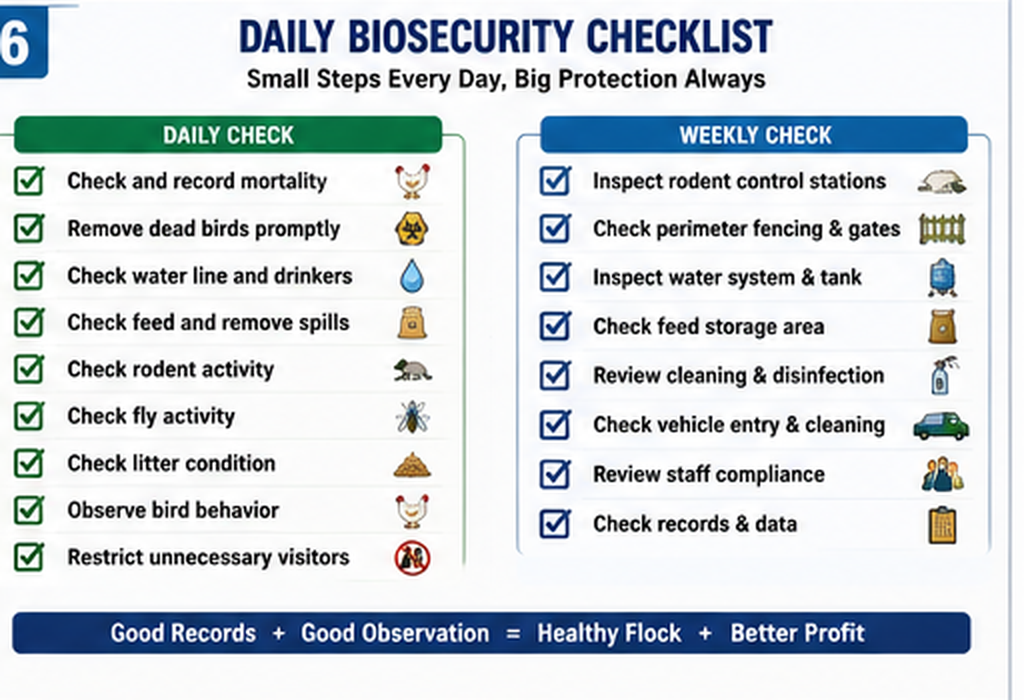
Downloadable Poultry Farm Biosecurity Checklist
Want to use these recommendations on your farm? Download the free Poultry Farm Biosecurity Checklist and use it for daily, weekly and between-flock checks.
[Download the Poultry Farm Biosecurity Checklist – PDF]
Print it and keep a copy in the farm office or use it during routine shed inspections.
Every Day
- Check mortality.
- Remove dead birds promptly.
- Check water availability and drinker leakage.
- Check feed spills.
- Inspect for rodents and flies.
- Observe litter condition.
- Check unusual changes in bird behaviour.
- Restrict unnecessary visitors.
Every Week
- Review mortality records.
- Check rodent-control points.
- Inspect fencing and doors.
- Check water systems.
- Inspect feed-storage areas.
- Review cleaning and disinfection practices.
- Check whether staff are following movement procedures.
After Each Flock
- Remove litter properly.
- Clean the house.
- Clean equipment.
- Disinfect appropriately.
- Allow adequate drying and downtime.
- Inspect the shed before the next flock arrives.
The exact programme should be adapted to the type of poultry operation and disease risks on the farm.
Final Thoughts
Biosecurity starts with the land on which the poultry farm is built and continues every single day after the birds arrive.
Farm location matters.
Shed design matters.
Water quality matters.
Rodent control matters.
Visitor control matters.
Cleaning matters.
But there is one thing that matters more than all of these: Consistency.
A farmer cannot follow biosecurity for three days and then forget it for the next ten.
Government of India guidance describes biosecurity as an integrated programme requiring continuous monitoring and evaluation rather than a one-time activity.
From a practical farming point of view, I would put it this way:
Don’t wait for disease to teach you the value of biosecurity.
By the time a serious outbreak arrives, it is usually too late to start building the system.
Build the system first. Train the people. Monitor the flock. Keep records. Correct small problems early.
That is how biosecurity becomes part of poultry-farm management rather than just another item on a checklist.
Frequently Asked Questions
What is biosecurity in poultry farming?
Poultry biosecurity is a set of practices designed to prevent disease-causing organisms from entering a poultry farm and to limit their spread between birds, sheds, farms and other locations.
What are the main types of poultry biosecurity?
For practical farm management, biosecurity is commonly discussed as conceptual, structural and operational biosecurity. Indian guidance also uses related categories such as managemental and personnel biosecurity.
Why is biosecurity important for poultry farmers?
Good biosecurity reduces the risk of disease entering and spreading through a flock. This can help protect bird health, production, farm continuity and profitability.
How can I improve biosecurity on my poultry farm?
Start with controlled farm entry, restricted visitors, dedicated clothing and footwear, vehicle hygiene, rodent and wild-bird control, clean water, feed hygiene, proper cleaning and disinfection, litter management and accurate mortality records.
Is vaccination enough to protect poultry from disease?
No. Vaccination is an important part of flock-health management, but it should work alongside biosecurity, hygiene, appropriate management and disease monitoring.
How often should poultry-farm water be tested?
The frequency depends on the water source, farm conditions and risk. Regular testing should include parameters relevant to the particular water source rather than relying on a single universal testing schedule.
What should I do if poultry mortality suddenly increases?
Restrict unnecessary movement and visitors, avoid spreading potentially contaminated material and contact your veterinarian or appropriate animal-health authority promptly. Unusual mortality should not be ignored.
References and Further Reading
- Department of Animal Husbandry & Dairying, Government of India — Poultry Disease Action Plan 2024, including biosecurity guidance for backyard and commercial poultry farms.
- Government of India — General Guidelines for Biosecurity at Poultry Farms.
- Department of Animal Husbandry & Dairying — Standard Veterinary Treatment Guidelines for Livestock and Poultry.
- Tamil Nadu Agricultural University — Biosecurity and Disease Management in Poultry.
- WOAH — Terrestrial Animal Health Code, Chapter 6.5: Biosecurity Procedures in Poultry Production.