A practical veterinary guide to symptoms, diagnosis, vaccination, biosecurity and control on Indian poultry farms
Read More »
Table of Contents
ToggleFew poultry diseases worry me as much as avian influenza. It can move from a single sick bird to a devastated flock in days, it can close markets and trade routes, and some strains can also affect other animals and, in rare cases, people.
When I started researching this topic for Poultrypedia, I found that most online material was either too technical for a farmer or too thin to be useful. This article is my attempt to fix that. I have written it as a veterinarian and poultry scientist, for poultry farmers, students and fellow veterinary professionals. I will explain the science where it matters, but I will keep coming back to one practical question: what should you do on your farm?
Avian influenza, commonly called bird flu, is a contagious viral disease caused by influenza A viruses. It mainly affects birds, but some strains can also infect mammals, including humans.
If you only have a minute, these are the points I want you to take away:
Avian influenza (AI), or bird flu, is an infectious disease caused by influenza A viruses. Historically it was known as fowl plague. The disease was first identified by the Italian scientist Edoardo Perroncito in 1878, when it was separated from other diseases that caused high mortality in birds.
Domestic poultry such as chickens, turkeys, ducks, quail and guinea fowl can all become infected. Wild aquatic birds, particularly ducks, geese and other water-associated birds, are important natural hosts for many influenza A viruses.
What makes this disease so difficult is that some wild birds can carry and shed the virus without appearing sick. A healthy-looking wild bird can still introduce the virus into a poultry farm.
An outbreak can affect:
Many poultry diseases reduce production. Avian influenza can do much more. A serious outbreak can result in:
That is why avian influenza is considered a major poultry-health and economic threat. If I could give farmers only one lesson, it would be this:
With avian influenza, prevention is far easier than control after the virus enters the farm.
Wild aquatic birds, in particular ducks, geese and swans (order Anseriformes) and gulls, terns and waders (order Charadriiformes), carry a large reservoir of influenza A viruses of many subtypes. The viruses can live in their respiratory and gastrointestinal tracts, and the birds shed them into the environment, often without any sign of illness.
The virus can contaminate:
Influenza A viruses can survive for long periods in water and at low temperatures. Domestic poultry become infected through contact with infected waterfowl or poultry, or with contaminated faeces, water or surfaces.
Wild birds travel along established migration routes called flyways. Eight major flyways are recognised for shorebirds worldwide, and for Indian poultry farms the Central Asia-India flyway is particularly relevant because migratory birds use this route. Risk often rises when migratory birds arrive or pass through an area.
However, I do not want farmers to think of avian influenza as only a “winter disease”. Biosecurity should be maintained throughout the year.
Influenza A viruses are RNA viruses with a segmented genome. The segmentation matters because it allows two different viruses to swap genetic material, a point I return to later.
Two proteins on the virus surface define its subtype:
Haemagglutinin (H) helps the virus attach to and enter host cells. There are 18 known haemagglutinin types, of which H1 to H16 have been found in birds.
Neuraminidase (N) helps newly produced virus particles leave infected cells and spread. There are 11 known neuraminidase types.
The combination gives subtypes their names, for example:
Almost all possible H and N combinations have been isolated from wild birds. But I need to stress an important point: the name alone does not tell us how dangerous a virus will be. Two viruses of the same subtype can behave very differently because other parts of their genomes differ.
Scientists use an international naming system that records the virus type, host, place, laboratory number, year and subtype. A well-known example is:
A/chicken/Nakorn-Patom/Thailand/CU-K2/04 (H5N1)
This tells us it is an influenza A virus, isolated from a chicken, in Nakorn-Patom, Thailand, with laboratory reference CU-K2, in 2004, with subtype H5N1. If the host species is missing from the name, the virus was isolated from a human.
Genetic sequencing lets scientists group viruses into clades and subclades and trace how they evolve. One you may read about is clade 2.3.4.4b H5N1, which has caused high mortality in wild birds, including migratory shorebirds, in recent years.
One of the most important distinctions in this disease is between:
These terms describe the ability of a virus to cause severe disease in poultry, particularly chickens. The classification system was devised in 1981, and by the original test a strain is HPAI if 75% or more of chickens die after deliberate infection. The system has since been refined to take into account the structure of the haemagglutinin protein. These terms do not simply mean “safe” and “dangerous”.
| Feature | LPAI | HPAI |
|---|---|---|
Disease severity |
Often mild or unapparent |
Often severe |
Mortality |
Usually low |
Can be extremely high |
Egg production |
May decrease |
Often falls sharply |
Respiratory signs |
Possible |
Common |
Sudden death |
Less typical |
Common |
Main concern |
May go unnoticed; some H5/H7 viruses can evolve |
Rapid spread and severe losses |
Control |
Surveillance and biosecurity |
Urgent official disease-control response |
LPAI does not always mean harmless. Some H5 and H7 low-pathogenic viruses can evolve into highly pathogenic forms in poultry. That is why, since 2006, the World Organisation for Animal Health (WOAH) has required all LPAI H5 and H7 detections to be reported, and why detections of these subtypes are notifiable regardless of pathogenicity.
Also remember:
Pathogenicity in chickens does not directly predict severity in humans or other mammals.
The virus can move between birds and between farms in several ways.
6.1 Direct contact. An infected bird can transmit virus to susceptible birds through respiratory secretions, saliva, faeces and other contaminated body fluids.
6.2 Contaminated water. Wild birds may contaminate ponds and water sources used by poultry. This is particularly important for outdoor and backyard birds.
6.3 Contaminated feed. Feed can become contaminated when wild birds, rodents or other animals gain access to feed stores.
6.4 Equipment. Virus can be carried mechanically on crates, feeders, drinkers, catching equipment, farm tools and vehicles.
6.5 People. People can carry virus on shoes, boots, clothing, hands and equipment. A person does not need to be sick to move virus from one place to another.
6.6 Other animals. Cats, scavengers and wildlife can be exposed to infected birds and may contribute to environmental contamination.
Commercial poultry houses hold large numbers of birds in close proximity, and commercial birds often have limited genetic diversity. Once a contagious virus enters a susceptible flock, it can move rapidly.
But commercial farms are not the only concern. Backyard and mixed-species farms face different risks because their birds have greater contact with wild birds, ponds, other domestic species, visitors and neighbouring flocks. Backyard systems often have weaker biosecurity, while intensive systems face faster spread once infection arrives.
Different production systems have different risks, but every poultry system needs biosecurity.
Clinical signs depend on the virus strain, its pathogenicity, the bird species, age, immune status and the presence of other diseases.
LPAI may cause:
This is exactly why laboratory surveillance matters. A flock can be infected without showing dramatic clinical disease.
HPAI can develop very quickly. The signs I would want any farmer to recognise are:
Sudden death. Birds may die before obvious signs are noticed.
Severe drop in egg production. Layers may show a rapid reduction in egg numbers, and eggs may be soft-shelled, misshapen or abnormal in quality.
Respiratory signs. Difficulty breathing, gasping, coughing, sneezing and nasal discharge.
Swelling. Of the head, face, eyelids, comb, wattles and shanks.
Dark or purple discoloration. Of the comb, wattles or other tissues. Haemorrhages on the skin and legs may also be seen.
Nervous signs. Tremors, incoordination, twisting of the head and neck, difficulty standing and seizures.
Diarrhoea and depression.
High mortality. In severe outbreaks, mortality can approach 100%.
Official poultry-health guidance highlights the same group of signs: sudden death, reduced appetite, reduced egg production, swelling, discoloration, respiratory signs and neurological abnormalities.
Ducks and geese deserve special attention. Some waterfowl can carry and shed influenza viruses while showing few or no signs of disease. So:
A healthy-looking duck is not necessarily a virus-free duck.
Mixed farming systems where ducks, geese and chickens share water, housing, feed, equipment and personnel create extra opportunities for transmission. Wherever possible, I recommend keeping different bird species separate.
Clinical signs alone cannot confirm avian influenza. Several other conditions can look similar, and the important ones I would think about are:
Newcastle disease is the closest look-alike, because its severe forms can also cause sudden death, respiratory disease and nervous signs. (If you have not read my post on it, you will find it on Poultrypedia.)
So please remember:
Do not diagnose HPAI by looking at the birds alone. Laboratory confirmation is essential.
Suspected avian influenza requires laboratory investigation. The main approaches are:
RT-PCR. A first-line method for detecting influenza A virus. Further testing then identifies the subtype and key characteristics, and sequencing can characterise the strain in more detail.
Virus isolation. Done in embryonated chicken eggs or cell culture. It remains an effective method.
Antigen tests. Antigen-capture tests can be useful for screening, but their sensitivity varies.
Serology. Antibody testing detects previous exposure and supports surveillance.
In poultry, commonly collected samples include oropharyngeal swabs, cloacal swabs, and samples from sick birds and freshly dead birds. The exact procedure should follow the instructions of the responsible veterinary authority or laboratory.
Do not collect, transport or submit suspected avian influenza material through informal channels. Use official veterinary channels.
For HPAI in commercial poultry, there is no practical treatment.
Antibiotics do not kill influenza viruses. A veterinarian may sometimes use them to manage secondary bacterial infections, but they do not cure avian influenza.
When HPAI is confirmed, disease control focuses on:
This is why waiting for a “medicine” before reporting suspected cases is extremely dangerous.
If several birds suddenly die or show suspicious signs, this is what I advise:
Step 1: Stop unnecessary movement. Do not move birds, eggs, equipment or other potentially contaminated material from the affected area.
Step 2: Restrict visitors. Keep unnecessary people out of the poultry area.
Step 3: Isolate the suspected flock. Prevent contact with other poultry as far as practical.
Step 4: Contact your veterinarian. Do this immediately.
Step 5: Contact the animal-health authority. Follow local official reporting procedures.
Step 6: Do not sell or hide sick birds. Selling or moving potentially infected birds can spread disease to other farms and markets.
Step 7: Use appropriate PPE. Anyone who has to handle sick or dead birds should be protected according to veterinary and public-health guidance.
Step 8: Follow official instructions. Do not decide independently how to dispose of birds, carcasses or contaminated material during a suspected or confirmed outbreak.
I would rather you call a false alarm than lose your flock, and your neighbours’ flocks, to a delay.
When HPAI is confirmed, control normally combines several measures working together.
14.1 Removal of infected birds. Depending on national policy and the situation, infected and exposed birds may have to be culled or depopulated. This is extremely hard for farmers, but rapid removal can be essential for stopping further transmission.
14.2 Movement restrictions. Authorities may restrict the movement of birds, eggs, feed, litter, equipment, vehicles and people within defined control zones.
14.3 Safe disposal. Carcasses, litter and contaminated materials must be disposed of according to official instructions.
14.4 Cleaning and disinfection. Buildings, equipment and vehicles need thorough cleaning and disinfection.
14.5 Surveillance. Birds in and around affected areas may be tested to find out whether the virus has spread.
14.6 Enhanced biosecurity. Neighbouring farms should strengthen their biosecurity immediately.
14.7 Compensation. Where government compensation programmes exist, they encourage farmers to report disease promptly rather than hide it.
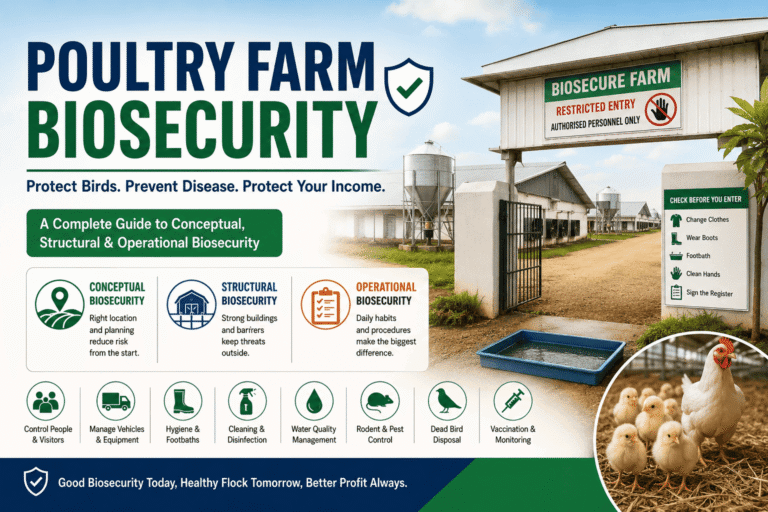
Biosecurity means the practical steps that prevent disease from entering a farm and stop it spreading if it does. For avian influenza, it should focus on breaking each route by which the virus can reach your birds. (My earlier post on biosecurity on a poultry farm covers the fundamentals in more detail.)
Avoid unnecessary mixing of chickens, ducks, geese, turkeys and other domestic birds, and keep domestic poultry away from wild birds and their contaminated environments.
Maintain a controlled entry point and limit visitors to essential personnel. Keep a visitor record where appropriate. Provide farm-specific footwear and clothing, hand-washing facilities and suitable disinfection facilities.
Farm workers should not carry contamination from one poultry area to another. Ideally:
Vehicles and equipment can mechanically carry infectious material. Pay particular attention to tyres, wheel wells, crates, catching equipment, feed equipment and tools. Clean before disinfecting, because disinfection works far better after organic material has been removed.
Avoid borrowing or lending crates, feeders, drinkers, catching equipment, tools and vehicles. If equipment must move, it should be thoroughly cleaned and disinfected before entering another premises.
Feed and water must not be accessible to wild birds. Protect feed storage, water tanks, drinking systems and feeders.
Buy birds from reliable, monitored sources. Quarantine new or returning birds where appropriate, and use all-in/all-out management where practical.
Good farmers notice changes early. Record:
A sudden change is a warning signal.
One of the most common mistakes I see described on farms is trying to disinfect dirty equipment. Remember:
Clean first. Disinfect second.
Manure, dust, litter, feed and secretions can all reduce the effectiveness of disinfectants.
For general guidance, public-health sources describe sodium hypochlorite (bleach) solutions and benzalkonium chloride-based products as examples of effective disinfectants, applied to saturate the surface and left for about 5 to 10 minutes before being wiped or rinsed away. For poultry premises, particularly during an outbreak, always follow the specific disinfectant, concentration and contact-time instructions issued by your veterinary authority or product label.
Dead birds can contain infectious virus. When I handle one, or advise someone to, the sequence is:
During a suspected or confirmed outbreak, do not choose a disposal method yourself if the authorities have issued specific instructions.
Anyone handling sick or dead birds, or working in contaminated areas, may need PPE. Depending on the work and official guidance, this may include:
How you take PPE off matters as much as wearing it. After work:
A study of dairy workers in the United States in 2024 found evidence of recent infection in about 7% of 115 workers, half of them without symptoms. All had worked in cleaning the milking parlour, and none had used PPE. PPE only works if it is actually worn.
Vaccines against avian influenza exist for poultry, but vaccination policy differs between countries and situations. Vaccination can be part of a broader control programme, but:
Vaccination is not a substitute for biosecurity.
A programme must be integrated with surveillance, disease detection, biosecurity, movement control and veterinary oversight. Vaccination also affects surveillance and international trade, because vaccinated birds must be monitored carefully to distinguish infection from vaccine response.
For that reason, no farmer should ever start an avian influenza vaccination programme independently. Follow the programme approved by the relevant veterinary authority.
Avian influenza is increasingly recognised as a disease that can cross species barriers.
H5N1 was first detected in dairy cattle in the United States in April 2024. Infected cows can have high levels of virus in the mammary gland and milk, and the virus can persist on milking equipment, making milk and milking equipment important in transmission. Pasteurisation is an important food-safety measure.
Cats can become seriously ill after exposure to infected birds or contaminated raw animal products, including raw milk and raw pet food. Possible signs include fever, depression, loss of appetite, eye or nasal discharge, breathing difficulty, tremors, seizures, incoordination and blindness. Dogs appear less likely to become infected.
As a veterinarian, I advise clients to prevent cats from hunting or eating sick and dead birds, to avoid raw animal products in pet food when avian influenza exposure is a concern, and to call a veterinarian promptly if a pet with possible exposure becomes unwell.
Avian influenza viruses have been detected in foxes, raccoons, skunks, seals, walruses and polar bears, generally after the animals fed on infected birds. This shows how widely some H5 viruses can infect.
Pig tissues carry both avian-type and human-type receptors, which makes pigs a possible “mixing vessel” for influenza viruses. I explain why this matters in Section 23.
Yes, although human infection remains uncommon. Most human infections have followed close, prolonged and unprotected exposure to infected animals or contaminated environments. The virus can enter through the eyes, nose, mouth and respiratory tract. Consuming raw or undercooked animal products, such as raw milk, has also been linked to infection.
Those at greater occupational risk include:
The World Health Organization recorded 993 confirmed human H5N1 cases and 477 deaths between 2003 and December 2025. The true fatality rate is probably lower than these numbers suggest, because mild cases may never have been identified.
Human disease ranges from mild to severe. Possible symptoms include:
Anyone who has had a significant unprotected exposure to potentially infected animals and then develops symptoms should seek medical attention promptly and tell the doctor about the exposure.
Avian influenza viruses are not normally efficient human-to-human viruses. Several biological barriers make sustained human transmission difficult.
Receptor differences. Avian influenza viruses prefer receptors (alpha-2,3 sialic acid) found in the respiratory and intestinal tract of birds, while human influenza viruses prefer receptors (alpha-2,6 sialic acid) found in the human upper respiratory tract.
Host defences. Proteins such as Mx1 inhibit replication of avian influenza viruses, and human-adapted viruses are less sensitive to it.
However, influenza viruses evolve, through two important mechanisms:
Antigenic drift. Small genetic changes build up over time and may reduce the protection offered by earlier infection or vaccination.
Reassortment. Because influenza genomes are segmented, a host infected with two different influenza viruses can produce viruses carrying a new mix of segments. In this way an avian virus can acquire properties that help it infect humans. Pigs, with both receptor types, are considered a possible site for this.
This is why scientists continue to monitor avian influenza closely through networks such as the WHO’s Global Influenza Surveillance and Response System, which tests millions of specimens a year in around 127 countries and also monitors avian and swine influenza viruses. For the general public, the current health risk is considered low, but the situation is watched carefully.
Properly handled and thoroughly cooked poultry meat and eggs are not considered a typical route of avian influenza infection. The main concern is exposure to infected animals and contaminated environments, especially when handling sick or dead birds.
For consumers:
During an outbreak, follow any specific food-safety instructions from the relevant authorities.
Where H5N1 infection is present in dairy cattle, raw milk can contain high levels of virus. Therefore:
Do not consume raw milk from animals that may be infected.
Pasteurised milk and dairy products are considered safe. Pets should not be fed raw milk either when avian influenza exposure is a concern.
India has experienced repeated avian influenza outbreaks. The country reported its first HPAI H5N1 outbreaks in poultry in 2006, beginning in the Navapur area of Maharashtra, and outbreaks have since occurred in other states and production systems.
India has a national framework for the prevention, control and containment of avian influenza, which involves:
As a veterinarian in India, my advice is firm: treat suspected avian influenza as a reportable animal-health emergency and contact your local veterinary or animal husbandry authorities promptly.
The cost extends far beyond the birds that die.
Direct losses. Birds, eggs, meat production, feed already invested and future production.
Culling losses. Large numbers of birds may need to be removed to control an outbreak.
Market disruption. Movement restrictions affect poultry sales, egg markets, chick supply, feed supply, transport and processing plants.
Trade restrictions. Countries or regions may restrict poultry products from affected areas.
Consumers. When millions of laying hens are culled, egg supply falls and prices rise. In the United States, wholesale egg prices in New York reached $8.53 per dozen in early 2025 before easing. Low-income households are hit hardest when this affordable animal protein becomes scarce.
Small farmers. For backyard and small commercial producers, even a small flock can be a vital source of food, income, household savings and emergency cash. An FAO report put the losses caused by avian influenza in South-East Asia up to 2005 at around US$10 billion, with the greatest impact on small commercial and backyard producers. Poultry provides roughly 20% of the protein consumed in developing countries.
This is why prevention matters so much for small poultry producers.
Yes. Both names describe the same group of diseases caused by influenza A viruses in birds.
No. H5N1 is one subtype among many. It is especially important because some H5N1 viruses have caused severe disease in birds and have also infected mammals.
Some H5 and H7 low-pathogenic viruses can evolve into highly pathogenic forms in poultry.
Yes. Some wild birds and certain domestic waterfowl can carry and shed influenza viruses with few or no visible signs.
No. Antibiotics do not kill viruses, and there is no practical treatment for HPAI in commercial poultry.
Treat it seriously. Restrict movement, avoid selling or moving birds, contact your veterinarian and notify the animal-health authority.
No. Do not move or sell potentially infected birds.
Yes, when done properly: remove organic matter first, then use an appropriate disinfectant at the correct concentration and contact time.
Yes. Cats can become infected after exposure to infected birds or contaminated animal products.
Yes, but it is uncommon and usually follows close exposure to infected animals or contaminated environments.
Yes. Properly cooked poultry is not considered a typical route of infection. The major risk is handling infected animals or consuming raw or undercooked products.
No. Raw milk may contain virus when cattle are infected. Pasteurisation is an important safety measure.
Use this regularly on your farm.
If you remember only five things from this article, I hope they are these:
Avian influenza is one of the most important infectious diseases in modern poultry production. For the poultry farmer, the basic message is straightforward:
Keep the virus away from your birds. Detect unusual disease early. Act quickly when something is wrong.
The virus can enter through wild birds, contaminated water, feed, equipment, vehicles, footwear, clothing and other routes, and once inside a susceptible flock it can spread extremely rapidly. There is no simple medicine that can rescue a commercial flock from HPAI. That is why biosecurity, surveillance, early recognition and rapid reporting remain the foundation of control.
A good poultry farm is not simply one with healthy birds today. It is one with systems in place to keep disease out tomorrow.
Keep wild birds away. Keep farm traffic controlled. Keep equipment clean. Monitor your flock every day. And never ignore sudden, unexplained mortality.
If you have questions about avian influenza or anything else in this guide, please leave a comment below, and I will do my best to answer. You can also read my related posts on Biosecurity on a Poultry Farm and Newcastle Disease.
This article is for educational purposes and draws on the following material:
Disclaimer: This article is for educational purposes and does not replace examination, laboratory diagnosis or advice from a registered veterinarian or official animal-health authority. If avian influenza is suspected, do not move or sell potentially affected birds. Contact your veterinarian and the appropriate animal-health authorities immediately.